The Great ARTdoors, a collaboration between the Urbana Park District, the Champaign Park District, UIUC College of Fine and Applied Arts, Allerton Park & Retreat Center, Illinois Arboretum, and 40 North, is kicking off a new cycle of awarding selected local artists stipends to create outdoor art installations in several Champaign and Urbana parks and community gardens. This program is once again guided by the belief that public art has the ability to visually and intellectually activate outdoor spaces by reinforcing social connectivity, providing a sense of belonging, and sparking dialogue. This project is also committed to compensating and validating local artists, prioritizing underserved communities, and ensuring accessibility for all.
The selected artworks will remain installed approximately through the end of November.
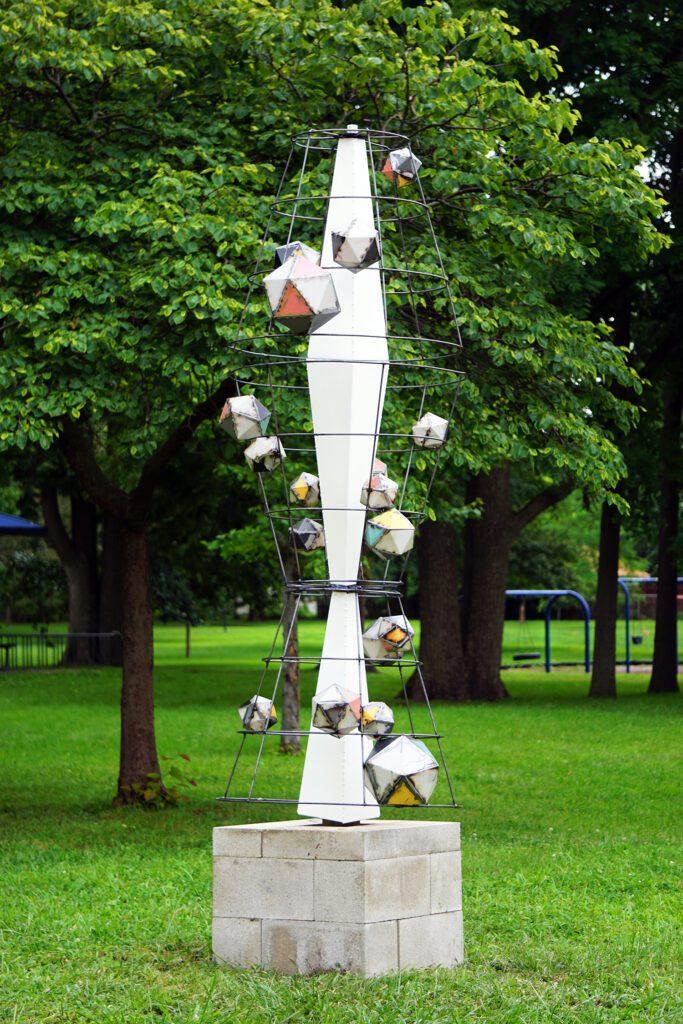
Nathan Westerman | Covalent Beacon | Victory Park, Urbana
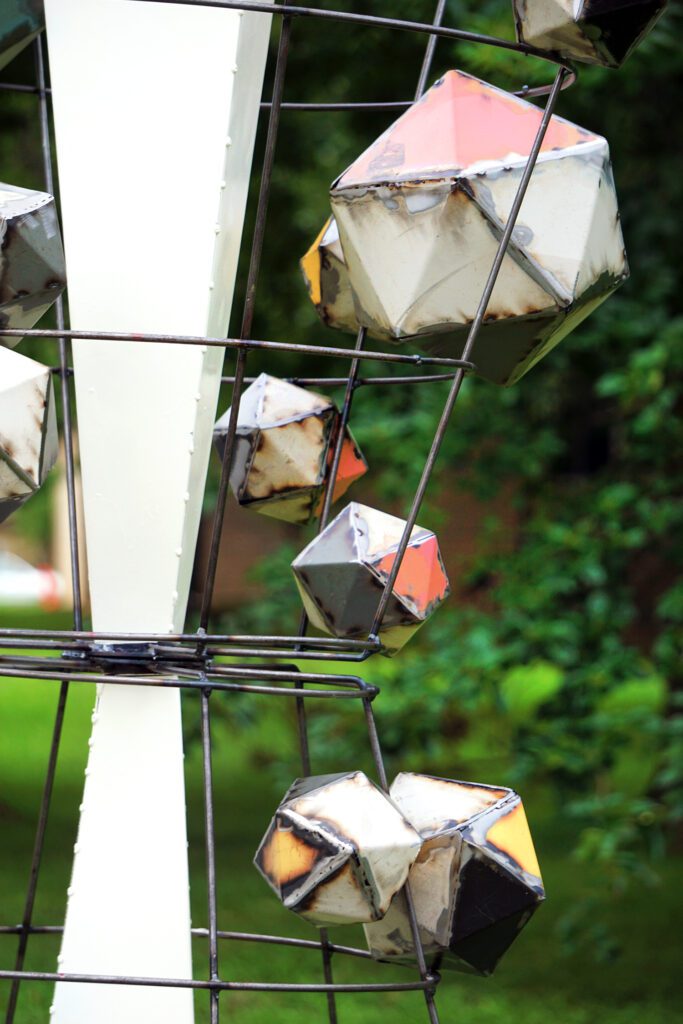
The sculpture is constructed from reclaimed steel fixtures and furniture from Urbana High School, such as desk, filing cabinets, lockers, ets. The materials were thrown away and then collected over a period of years for this project, and others like it. The existing paint on the steel remain on the finished artwork, referencing place and a history of the material. The reclaimed steel is cut and welded into polyhedrons (dodecahedrons, Icosahedrons) attached to a galvanized vertical geometric column, referencing segments of Brancusi’s Endless Column. The structure is body/universe/electromagnetic field/everything/nothing. The rings mimic planetary gravity/bodies/vessels/a focused path. The galvanized shapes are broken segments of infinity or moments.
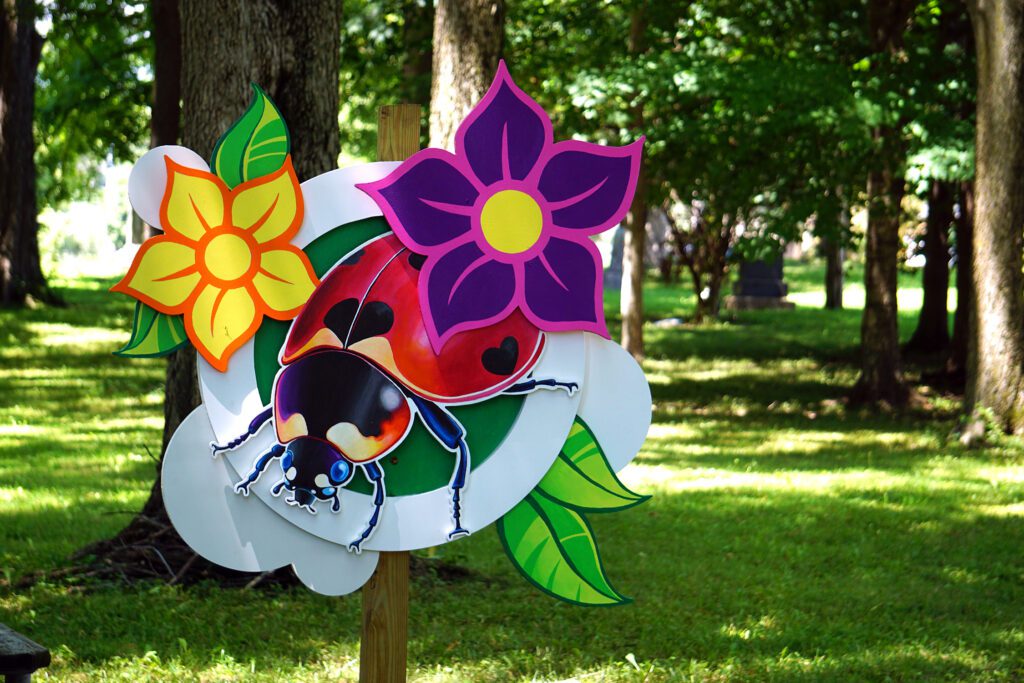
Jose Vazquez | Love Bug | Chief Shemauger Park, Urbana
My completed piece celebrates the often-overlooked life that thrives in nature, inviting viewers to appreciate the beauty hidden in the smallest details of the natural world. The artwork features a delicate ladybug as its central subject, surrounded by elegant, decorative floral designs that enhance its presence without overshadowing it.
Constructed from multiple layered panels cut into organic, flowing shapes, the composition creates depth, texture, and a sense of movement. Each layer has been fully painted in vibrant, natural colors, bringing the scene to life while emphasizing the intricate details of both the insect and its floral surroundings.
The finished work is displayed within a wooded setting, allowing the artwork to blend with its environment and encouraging viewers to slow down, observe, and reconnect with the small wonders of nature that are so often passed by during everyday walks.
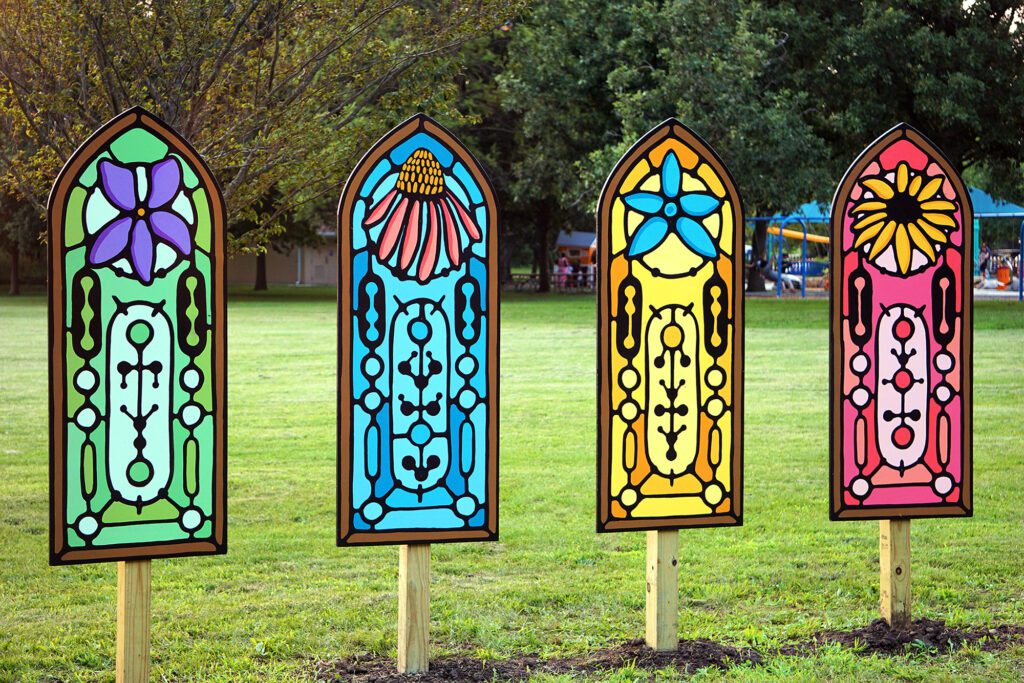
Cameron Raab | Prairie Palette | Meadowbrook Park, Urbana
This installation consists of four arched wooden panels, hand-painted to resemble vibrant stained glass. Each panel celebrates a favorite native plant from a different season, reflecting both my artistic practice and my passion as a certified Master Gardener and advocate for native plants. This concept has lived in my imagination for years and bringing it to life through this installation has been incredibly meaningful.
The work honors native plants as subjects worthy of admiration and reverence, much like the stained glass traditionally used to celebrate people, stories, and places of significance.
The four featured native flowers, from left to right, are Common Violet, Purple Coneflower, Eastern Bluestar, and Black-eyed Susan. Together, they represent the beauty, resilience, and ecological importance of native plants while inviting viewers to appreciate the essential role they play in our environment.
Each panel was cut, painted, and sealed by hand to ensure durability and protection from the elements while providing a lasting public artwork that celebrates the natural beauty of our region.
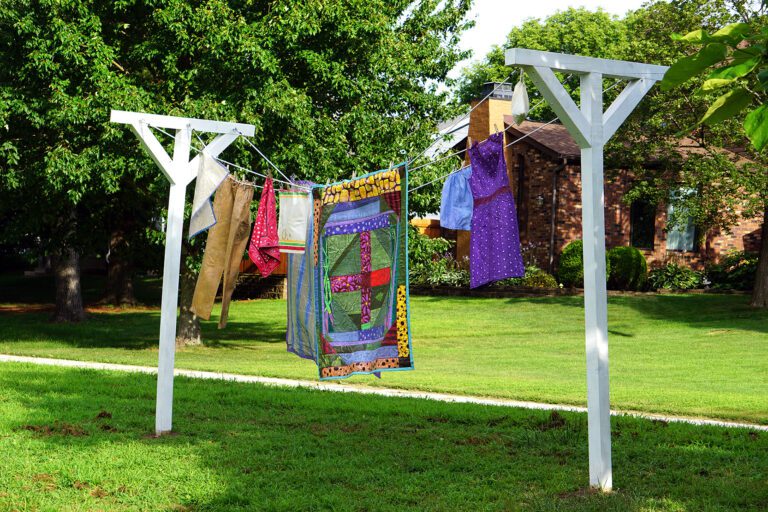
Amy Kesler | Unsung: The Patience and Persistence of the Overlooked | South Ridge Park, Urbana
This outdoor installation reimagines a traditional clothesline as a celebration of community, labor, art, and the natural world. Constructed with vintage-style clothesline posts, cables, and hardware, the work features large, weather-treated quilts created from discarded work clothing. The quilt surfaces are painted with vibrant, stylized depictions of native plants and animals, using bright colors, shapes, and patterns to invite curiosity and discovery. Suspended like freshly washed laundry, the quilts are shaped to suggest movement in the wind, while painted reverse sides and additional treated garments further enrich the installation.
The materials and imagery carry layered meaning. Repurposed work clothes honor the dignity of all labor, especially the often-overlooked work that sustains communities. The clothesline evokes the traditionally undervalued domestic labor historically performed by women, while the quilts recognize a rich artistic tradition that has too often been dismissed as mere craft despite its cultural and creative significance. By centering native plants and animals, the installation also encourages viewers to appreciate and protect the region’s natural heritage, inviting families and children to identify local species and seek them out in nearby parks and natural spaces. Together, these elements create an artwork that celebrates resilience, connection, and the enduring importance of nature, creativity, and community.
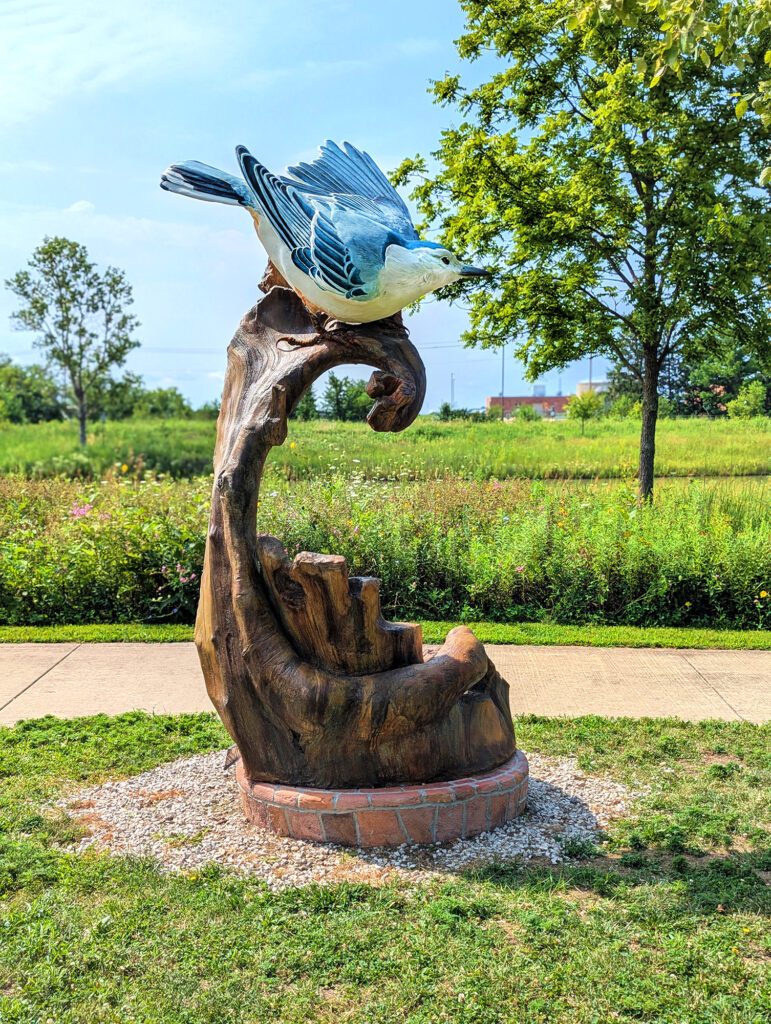
Shawn A. Hensley | PERCH | Robert C. Porter Family Park
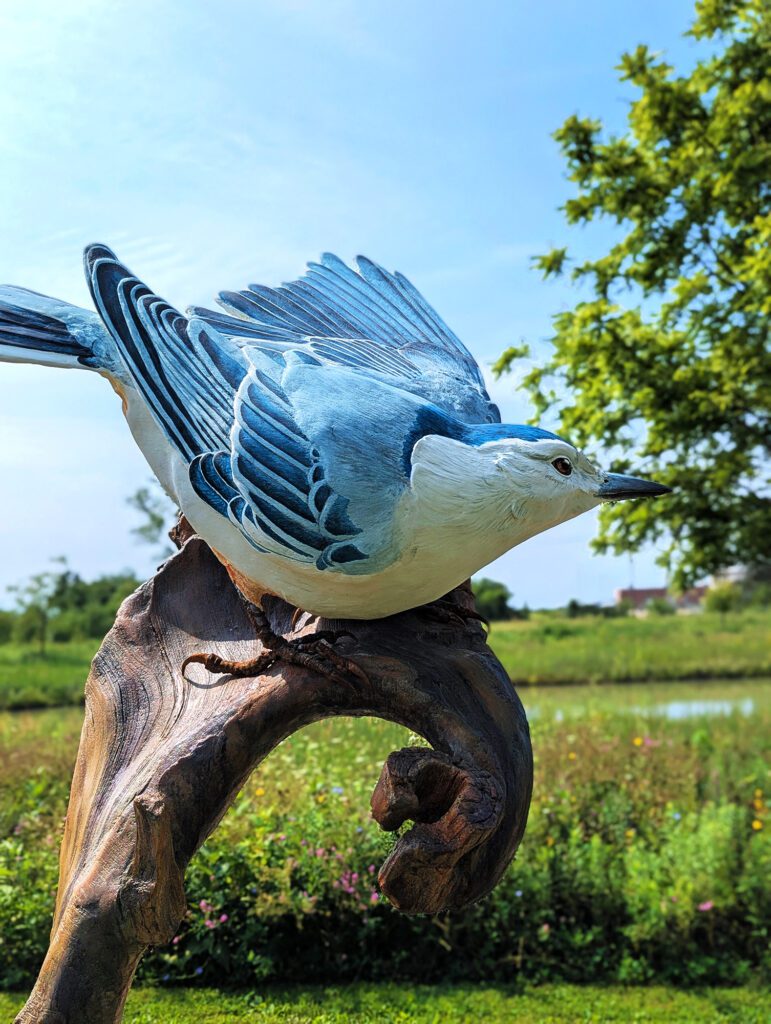
PERCH is an interactive sculptural installation that creates a place to rest, talk, reflect, and daydream—an invitation to inhabit nature rather than simply observe it. Composed of a base, a column (seat), and a capital (bird), the work draws from classical architectural forms while grounding it within the landscape. The base, rendered as aged red brick, evokes the state’s neighborhoods, main streets, and industrial corridors, symbolizing the generations of Illinoisans whose labor and stories form the foundation of our shared civic life. Rising from this structure, the column takes the shape of a weathered tree branch painted in rich umbers, ochres, greens, and washed blacks, representing the present moment—organic, textured, and shaped by time—where visitors are invited to sit on a worn red leather cushion that suggests both leadership and collective agency. At the top rests a white-breasted nuthatch, native to Illinois woodlands, a bird known for moving in any direction and foraging cooperatively, symbolizing adaptability, community, and the shared pursuit of happiness rooted in our natural environment. By combining built history, lived experience, and native ecology, the piece lifts local stories while honoring Illinois as a place where democracy is grounded, sustained by nature, and shaped by the people who gather within it.
EKAH | Bloom | Martens Center
This project invites viewers to engage and move around the piece. As the cluster of cubes shifts in appearance, it reveals different visual relationships and compositions from every point of view. This changing perspective creates a dynamic, animated experience in which the viewer becomes an active participant in the work.
The piece is composed of approximately 54 cubes arranged into an organic form inspired by nature, creating the impression of components captured in full bloom. The completed work features a vibrant, energetic color palette that enhances its sense of movement, transformation, and visual discovery. Installed approximately six feet above the ground, the cluster encourages viewers to move around and experience the work from multiple vantage points.
The installation builds upon my previous The Great ARTDoors series, which incorporated a lenticular aspect through moving imagery that changed as viewers shifted their perspectives. This body of work grew from my passion for the art of animation and my belief that art should be accessible to everyone. In this installation, those ideas are translated into a sculptural form, using physical space and the movement of the viewer to create an experience that is both playful and engaging.
The piece is primarily constructed from wood and finished with acrylic paint. The combination of sculptural geometry, vibrant color, and changing perspective transforms the individual cubes into a unified, animated composition. As viewers circulate around the installation, the work continually reveals new forms and relationships, encouraging curiosity, movement, and sustained interaction.


Andy White | Grace | Mattis Park
Grace is a monochrome/grayscale triceratops and companion piece to Beauty, currently installed at Meadowbrook Park. Created in 2017, Grace explores the ideas of rising up, transformation, and emergence through both posture and color.
The creature rears upward on its hind legs, creating a sense of movement and becoming. Its coloration transitions gradually from black at the tail, through shades of gray in the midsection, to white at the head, where its shiny horns catch and reflect the light. Measuring approximately 7.5 feet long, 5.25 feet high, and 2.6 feet wide, Grace has a strong presence and emphasizes rising momentum.
For the current installation, Grace is secured to a steel plate base attached to a 4×4 post. A sign on the post identifies the work as “GRACE,” with lettering in colors that echo the grayscale progression of the sculpture. At night, the sign is illuminated by a solar-powered barn light, creating a subtle glow around the work.
The intention is for Grace to function almost as a beacon – drawing attention while reinforcing themes of transformation, emergence, and moving forward.


Gregory Stallmeyer | Lux Spei | Bridgewater Park
Lux Spei, meaning “Light of Hope” explores the human capacity to find light within moments of uncertainty, struggle, and transformation. The sculpture represents hope not as something distant or fragile, but as an inner presence that continues to emerge from the darkness
Through form, light, and shadow the work reflects the tension between vulnerability and resilience, inviting the viewer to consider hope as an active force – a choice to continue, to heal, and believe in the possibility of something beyond the present moment.
Automotive paint
Repurposed aluminum and plexiglass


David Tracy | “Are They Here?” | Dodds Park
An alien craft of unknown length appears to have nose-dived into the grassy lawn at a rakish angle, with an almost 11 feet length visible above ground. The middle section (perhaps a reactor of some sort?) has obviously sustained major damage, possibly due to impact by a micro-asteroid or errant space debris. Sod displaced by the impact surrounds the nose section. Curiously, a tiny rope ladder descends from an open hatch, suggesting that there may have been diminutive survivors. The craft is evidently not dead – occasionally there are lights and glows visible within through the portholes, and sometimes various strange low sounds can be heard coming from somewhere inside the stricken vehicle. Scanners may be spotted rotating in an observation dome from time to time. The infamous GSB (Global Security Bureau) has put up a yellow tape “do not cross” barrier around the site for the protection of onlookers, with a sign warning of possible short range “Trans-muonic Radiation” leaking from the damaged reactor. Another sign placed there by the artist for his protection, states that this installation was certainly not inspired by actual events, and that the craft in question definitely did not impact his CU backyard at 2:43 AM on May 13, 2026.


Lisa Kesler | Morning in the Park | UIUC Arboretum
Public art projects like The Great ARTdoors highlight and celebrate our shared outdoor spaces. My piece is titled Morning in the Park. It is a vertical square column approximately six feet tall and fourteen inches wide. The column is covered with colorful, stylized imagery of garden plants and wildlife. It is designed to appeal to both children and adults. The colors make it visible to be enjoyed from a distance or up close.

Kelly Hieronymus | Soft Infrastructure | Crystal Lake Park
SOFT INFRASTRUCTURE is an installation made of three 4-foot-tall replicas of power line structures. The installation includes three different forms: a traditional wooden utility pole with crossbars, a lattice-style transmission tower, and a simplified T-shaped pole. Each structure is scaled down to human size and painted in a color palette of warm yellows, pale wood tones, cream, coral, red-orange, aqua, light blue, teal, green, and bright yellow accents. Power lines are a familiar part of our midwest landscape. They cross fields, roadsides, neighborhoods, and parks. They divide our sky but quietly connect one place to another: this project playfully brings to light their existence in our life, as we tend to stop noticing them. By reducing the scale and changing the color of these structures, Soft Infrastructure transforms utility objects into public sculpture. The work becomes less about function and more about noticing: noticing the built environment, noticing the lines that move across the prairie, and noticing the strange beauty in the systems that connect us. The sculptures are arranged in a loose line echoing the way power lines recede across open land. The installation is also rooted in my broader studio practice. I am interested in the prairie, agricultural pattern, grids, rows, boundaries, and the tension between wildness and structure. These small power line sculptures continue that investigation by looking at the visual systems that shape the Midwest. They are evidence of human presence within the landscape.


Curt Walker | Elegy for a Prairie Tree | Allerton
Elegy for a Prairie Tree is a sculptural work composed from the remains of a tree once rooted in prairie soil, now transformed through human intervention into a site of reflection. The piece retains the physical memory of the tree’s original form—its trunk, branching structure, and weathered surface—while reconfigured in a way that emphasizes absence as much as presence. Rather than concealing the tree’s history of cutting and removal, the work holds it openly. Cuts, joints, and altered alignments remain visible, marking the moment where natural growth met human action. These interventions become part of the sculpture’s language, underscoring a tension between reverence and extraction, loss and preservation. The verticality of the form evokes standing, witnessing, and mourning. At the same time, the altered structure resists the idea of intactness; it is not a preserved specimen, but a reconstructed body. In this way, the work functions as an elegy—an acknowledgment of what has been taken from the prairie landscape, and what can no longer return in its original form. Installed in space, the piece asks the viewer to move around it slowly, to consider scale, weight, and the quiet force of natural systems that existed long before and continue beyond human presence. It is both artifact and offering: a record of what was, and a gesture toward remembrance within a changing landscape.